
Southwest: A Nuisance That Starts Early and Lingers
Southwest: A Nuisance That Starts Early and Lingers
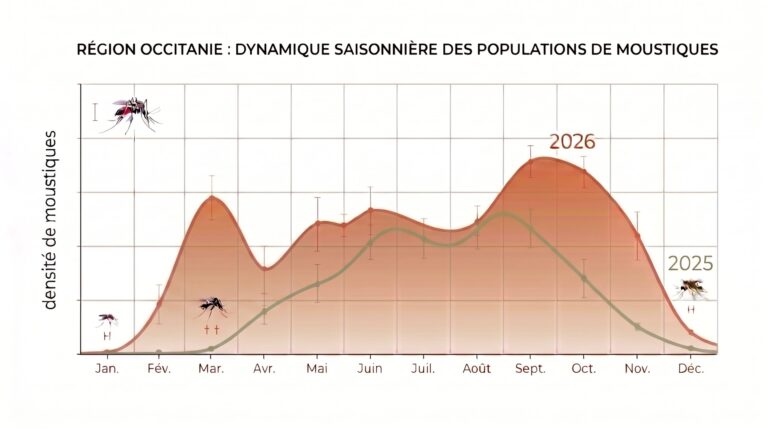
In the Southwest, the 2026 season was particularly early. Mild temperatures combined with heavy rainfall in late winter and early spring favored the waterlogging of wetlands and triggered the emergence of rural mosquitoes as early as February and March—a phenomenon unprecedented in its scale and earliness. Populations of Aedes detritus and then Aedes caspius, characteristic of wetlands, thus generated locally almost unbearable nuisances from the very start of the season.
These species can emerge in very large numbers after their habitats become waterlogged and disperse toward inhabited areas, quickly making nearby gardens, terraces, and outdoor spaces uncomfortable. Aedes albopictus, more discreet due to the intense heat, saw a resurgence at the end of summer.
Autumn was also marked by a resurgence in marsh mosquito activity, linked to mild temperatures and heavy rainfall. As in February-March, the scale of the nuisance observed in October remains particularly rare for this time of year. Abundant rains, which promote the waterlogging of wetlands, combined with temperatures that were still mild, contributed to these new emergences and the sustained activity of adult mosquitoes. The year 2026 thus illustrates the evolution of a nuisance that can begin very early and persist over an increasingly long period, lastingly degrading outdoor living conditions.
There is a before and an after BioBelt. Our clients never go back
"We were looking for a natural solution that respects our gardens, while providing comfort to our guests. They are delighted to enjoy our spaces and our rooms peacefully. "
— Audrey Jorge Director of Mas de Pierre
“Afternoons and evenings were becoming hellish, and we had tried everything. Today we don't even worry about mosquitoes anymore. We have regained a freedom we thought was impossible.”
— Vanessa P.
“It is a system that is extremely effective, which works almost to perfection.”
— Antoine C.
“We could no longer enjoy the terrace or the garden. Today we fully enjoy all our outdoor spaces, and that is a real pleasure.”
— Eric B.