
When looking for a solution to protect against mosquito bites in a garden, several options are available.
It is essential to differentiate between temporary solutions and integrated protection systems, which operate across all outdoor areas. For mosquito control, a device’s effectiveness is not solely determined by its capture rate or repellent power; it primarily depends on its ability to create a real and lasting protection zone for occupants.
Which Mosquito Control Solution Is Most Effective for a Garden?
There is no single universal solution for controlling mosquitoes in a garden. Effectiveness primarily depends on the scale at which action is taken.
Three main approaches can be distinguished:
1. Temporary Solutions
These improve immediate comfort around individuals: coils, candles, or fans.
2. Insecticide Treatments (Adulticides)
These quickly reduce the adult mosquito population present at the time of treatment, but their effect is generally temporary and requires repeated applications.
3. Networked Capture Systems
These devices aim to intercept mosquitoes before they reach living areas, providing lasting protection for the entire garden.
The remainder of this article explains the operation, advantages, and limitations of each of these approaches.
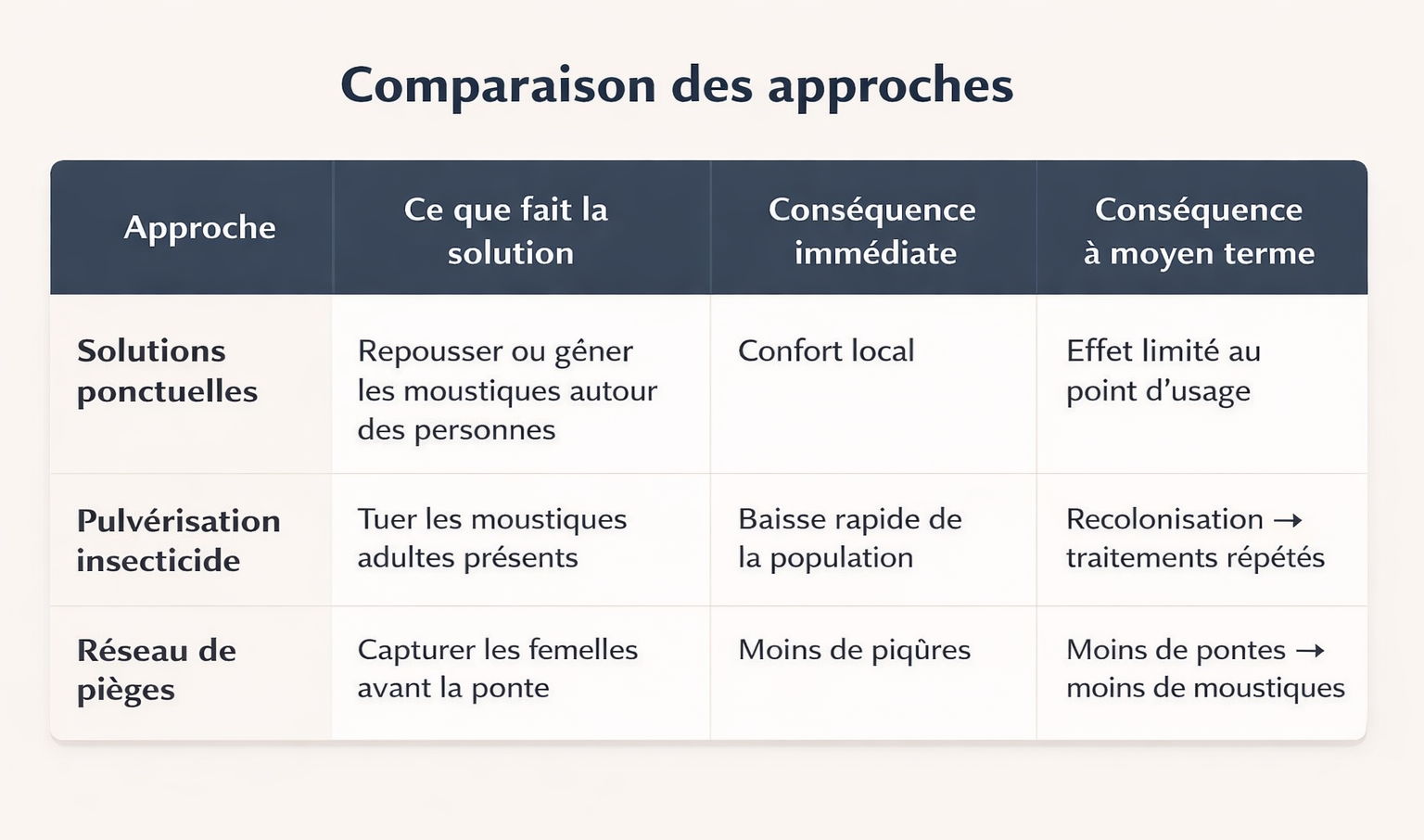
Thus, two main categories of solutions can be distinguished:
1. Localized Action Devices
These solutions improve immediate comfort around individuals, but their effect is limited to a restricted area.
These solutions, which act within a limited radius and for a restricted duration, include:
- Pyrethrum-based coils and lanterns
- Mosquito repellent candles
Fans
Their effectiveness, though documented, does indeed improve immediate comfort in a restricted area. However, several studies highlight their limitations in a context around the home: on the one hand, their reduced range does not cover all living areas, and on the other hand, the continuous influx of mosquitoes from surrounding spaces compromises their long-term effectiveness. Furthermore, some of these formulations contain active substances whose toxicological profile calls for judicious use.
2. Strategies Aiming to Affect the Entire Garden
Some approaches aim to limit the presence of mosquitoes across the entire property.
Other approaches aim for a larger-scale action:
- Adulticide treatments by nebulization
- Spatial repellent diffusers
- Individual capture traps
These methods aim to limit the presence of mosquitoes over a wider area.
Two very different strategies stand out among these approaches:
on one hand, insecticide spraying, which temporarily eliminates adult mosquitoes;
on the other, networked capture systems, such as BioBelt.
Insecticide Spraying: How Adulticide Treatments Work
How Adulticide Treatments Eliminate Adult Mosquitoes
Adulticide treatments encompass several application methods:
- Cold or hot nebulization
- ULV (Ultra Low Volume) spraying
- Automated misting systems
- Residual treatments on vegetation
The principle relies on dispersing an insecticide aerosol whose droplets come into contact with flying mosquitoes, causing their death by disrupting the nervous system.
Rapid but Often Temporary Effectiveness
The undeniable advantage of this approach lies in its ability to rapidly reduce the adult mosquito population present at the time of treatment.
However, several factors limit its long-term scope.
Mosquitoes Rapidly Recolonize Treated Areas
Eliminated mosquitoes leave a vacant territory that will be quickly recolonized from:
- Untreated refuge areas (dense vegetation)
- Peripheral larval breeding sites
- Adjacent properties
- Surrounding natural spaces
This recolonization dynamic, well-documented in population ecology, necessitates repeated interventions throughout the season.
External Conditions Reduce the Duration of Insecticide Effectiveness
The persistence of insecticides in outdoor conditions is affected by multiple abiotic (environment-related) factors:
- Photodegradation under UV light
- Leaching by precipitation
- Dilution by dew
- Thermal degradation
- Adsorption on vegetation
These phenomena significantly reduce the effective duration of efficacy, requiring frequent reapplications.
Environmental and Evolutionary Limitations of Insecticide Treatments
Although current formulations comply with strict regulatory standards, adulticides remain broad-spectrum pesticides, capable of affecting non-target entomofauna (beneficial insects).
Furthermore, the repeated use of insecticide treatments exerts selection pressure (natural selection) on mosquito populations.
Individuals carrying genetic mutations that confer insecticide resistance survive treatments and transmit these genes to their offspring.
This phenomenon is widely documented in several species:
- Aedes aegypti
- Anopheles gambiae
- Culex pipiens
Trap Networks: An Approach Based on Mosquito Interception
How Attractive Traps Work
An alternative is to intercept mosquitoes before they reach living areas.
This strategy relies on traps combining:
- Olfactory lures (mimicking human odors)
- Carbon dioxide (CO₂)
- Mechanical capture by aspiration
Why Organizing Traps in a Network Changes Effectiveness
An isolated trap operates within a limited radius.
Conversely, a properly sized network forms a capture barrier around living areas.
This approach, used by BioBelt, is based on:
- sizing adapted to the area
- optimized trap distribution
- centralized management ensuring system continuity
How Capturing Females Can Reduce Mosquitoes Over the Season
The systematic interception of females before biting leads to a significant demographic effect.
By dying in the traps, females can no longer lay eggs.
Over the course of the season, this continuous capture pressure can gradually reduce the local population in a virtuous cycle:
- Reduction in the number of bites
- Decrease in egg-laying
- Decline in the emergence of new adults
Over time, mosquito pressure can be sustainably reduced around protected areas.
Comparison of the Two Approaches
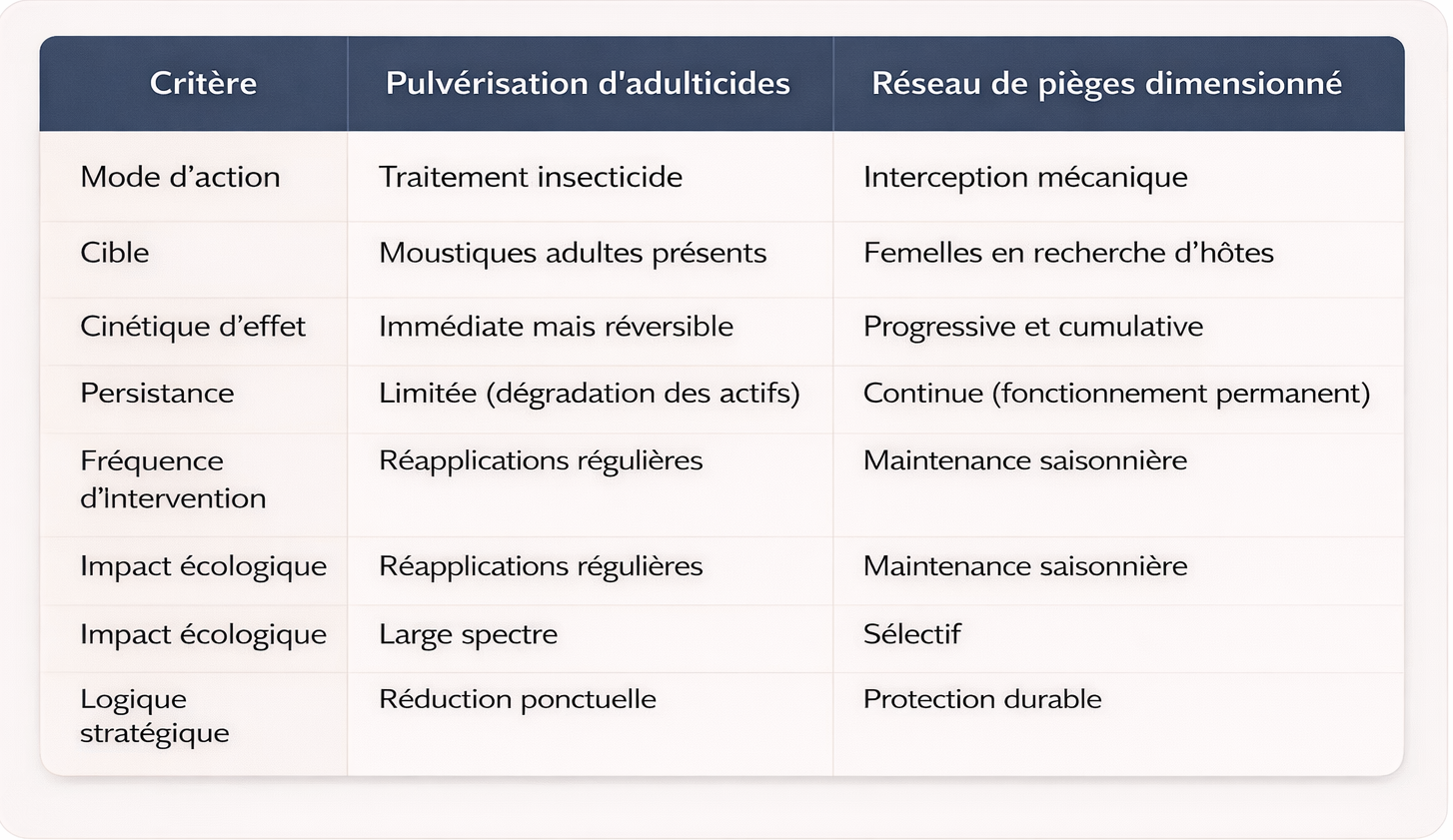
Summary: Two Different Logics for Mosquito Control
Mosquito control at the property level relies on two distinct philosophies:
A temporary intervention logic, with insecticide treatments providing a rapid but temporary reduction in populations.
A systemic protection logic, in which a sized network of traps intercepts mosquitoes before biting and progressively impacts population dynamics.