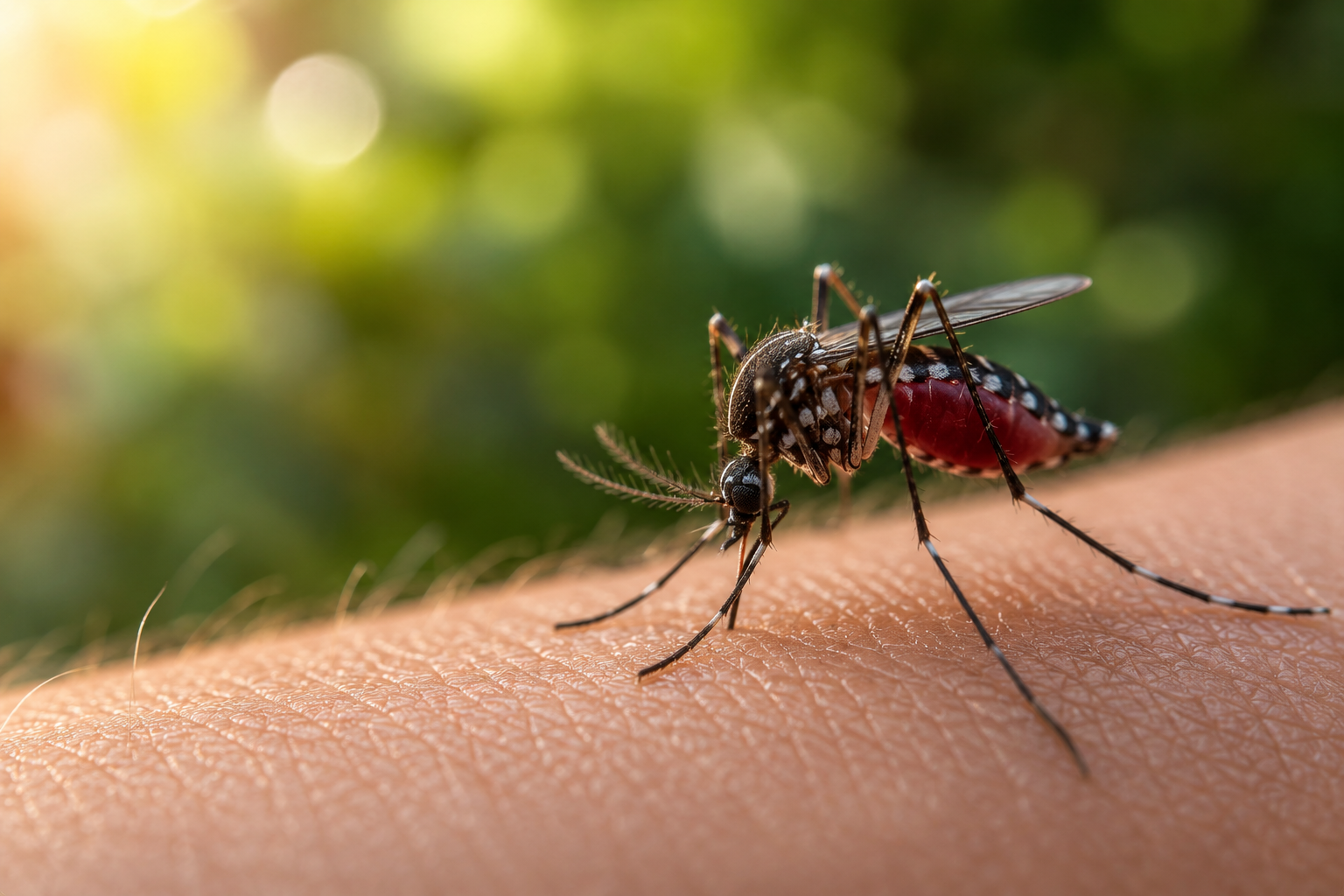
When looking for a solution to protect yourself from mosquito bites in a garden, several possibilities exist.
It is essential to differentiate ad hoc solutions from integrated protection systems, which act on all outdoor spaces. In terms of mosquito control, the effectiveness of a device is not limited to its capture rate or its repellent power: it depends above all on its ability to create a real and lasting protection zone for the occupants.
It is thus possible to distinguish two main categories of solutions.
Localized action devices
These solutions improve comfort around people, but their effect is limited to a limited space.
These solutions, which operate within a limited radius and for a limited period of time, include:
- Pyrethrum-based spirals and lanterns
- Mosquito repellent candles
Their effectiveness, although documented, actually makes it possible to improve immediate comfort around a restricted space. However, several studies highlight their limitations in a context peridomiciliary (around the house) : on the one hand, their reduced range of action does not cover all living areas, and on the other hand, the continuous influx of mosquitoes from the surrounding areas compromises their lasting effectiveness. Moreover, some of these formulations contain active substances whose toxicological profile calls for rational use.
Strategies that seek to protect the entire garden
Some approaches aim to limit the presence of mosquitoes throughout the property.
Other approaches aim at action on a larger scale:
- Adulticide treatments by nebulization
- Diffusions of spatial repellents
- Individual catch traps
The aim of these methods is to limit the presence of mosquitoes over a larger area. Individual catch traps fall into this category and are often touted as an effective outdoor solution.
However, a fundamental distinction is seldom put forward:
An insulated trap captures mosquitos that pass by.
A properly sized network can protect a space by intercepting mosquitoes before they reach occupants.
That's all the difference between a Simple capture And a real protection.
How do individual mosquito traps work
The individual traps exploit the behavioral mechanisms of female mosquitoes in search of blood meals. They generally combine:
- Olfactory attractants mimetic of human odour
- Carbon dioxide (CO₂) simulating human breathing
An aspirated capture system
In search of blood, females detect these signals and head for the source. Once in the vicinity, they are sucked up and trapped in a net. These devices can capture large numbers of individuals and thus reduce the local population. However, this does not guarantee effective protection of living areas.
Why an isolated trap is not always enough in a garden
Field data shows that these devices have several significant limitations.
During their host-seeking phase, mosquitoes can converge from various directions from their surrounding resting area:
- Dense vegetation (hedges and shrubs)
- Shaded and humid areas of the building (cellars, garages)
- Peripheral natural areas
A mosquito trap works within a limited radius. It therefore does not ensure systematic interception across all trajectories leading to people.
The greater the area to be protected, the more likely it is that mosquitos will reach the occupants without going near the trap.
Multiplying the traps does not guarantee homogeneous protection
Faced with this limit, the idea of multiplying individual pitfalls may seem intuitive. Certainly, this strategy increases the number of catches. However, it does not ensure homogeneous protection of living areas.
Placed without coordination, the traps act separately. They catch mosquitos that pass by, but don't necessarily intercept those that follow the odor feathers (olfactory gradients) leading to people.
The effectiveness of the protection then depends on several factors:
- The location of the traps
- Mosquito trajectories
- The characteristics of the land
In practice, this approach often remains fragmented and random. Its long-term management is complex, each trap operating independently, without centralized control to guarantee homogeneous and continuous protection throughout the area.
The concept of an organized and dimensioned trap network
An organized network can intercept mosquitoes before they reach living areas.
How a network of traps protects living areas
The fundamental difference between an individual trap and an organized network is based on the approach:
- The individual trap captures mosquitos that pass by
- The dimensioned network intercepts mosquitoes on their path towards the occupants.
A properly configured network implies a strategic positioning of the modules at the periphery of the spaces to be protected, creating a capture barrier that mosquitoes must pass before reaching frequented areas.
What makes a trap network really effective
Several parameters determine the effectiveness of a protection network:
- A coverage density adapted to the surface
- A homogeneous distribution of modules
- The operational continuity of the system
- Coordinated management of units
This systemic approach, illustrated by solutions such as BioBelt, makes it possible to ensure a methodical interception of mosquitoes throughout the protected perimeter.
A simple comparison to understand the principle
This can be compared to a home security system.
An isolated trap acts as a unique camera in a garden : she observes what is in front of her, but does not see what is happening elsewhere.
Multiplying cameras without overall reflection does not necessarily ensure effective protection.
Conversely, an organized trap network works like a perimeter security system, designed to monitor all accesses to the protected area.
Intruders are then detected before you even reach home.
How catching females can reduce mosquitos throughout the season
The systematic interception of females before the sting induces a significant demographic effect.
By dying in the traps, the females can no longer lay eggs. At the seasonal level, this continuous catch pressure can gradually reduce the local population in a virtuous cycle:
- Reduction in the number of bites
- Decrease in egg laying
- Decline in the emergence of new adults

Synthesis
Effective protection is based on a network that is sized, coordinated and operates continuously.
The effectiveness of a mosquito control strategy in outdoor areas is based on three fundamental parameters:
- The dimensional suitability of the device for the surface to be protected
- The spatial organization of modules in a coherent network
- Operational continuity ensured by centralized management
This integrated approach goes beyond simple point capture to achieve sustainable protection of outdoor spaces.